Walking to the Tomb Together: Holy Week and Easter for Interchurch Families

Melanie Carroll • March 31, 2026

Walking to the Tomb Together: Holy Week and Easter for Interchurch Families

Walking to the Tomb Together: Holy Week and Easter for Interchurch Families


There is a moment that many interchurch families know well. It happens at the Communion rail, or the table, or the moment of distribution — whatever your traditions call it. Someone you love moves forward, and you stay in the pew. Or you move forward, and they stay. Holy Week and Easter, of all the seasons in the Christian year, make that moment feel both sharper and, strangely, more bearable. Because the whole story we are walking through is about precisely this: death, separation, the unbearable waiting, and what breaks through on the other side.


Holy Week is not one thing. It is a gathering of experiences — triumphal and terrifying, intimate and cosmic — and different Christian traditions enter it through different doors. Some families mark Palm Sunday with a full liturgical procession, palms in hand, in one tradition, and a simple gospel reading and reflection in another. Maundy Thursday may mean a Seder-influenced Last Supper meal in one church, a solemn stripping of the altar in another, foot-washing in a third. Good Friday could bring the Stations of the Cross, a Three Hours devotion, a plain service of readings, or a walk of witness through town with Christians from every denomination on the street together — which is often where interchurch families feel most themselves.


For many of us, Holy Week is actually the week when being an interchurch family feels most visible. Because the services multiply. Because the question of where you worship together, and where you worship separately, has to be answered again, practically, in the diary. Some couples divide the week: she attends the Tenebrae at her Catholic parish, he attends the Good Friday service at his Methodist chapel. Some go to everything, developing a Holy Week stamina that is exhausting and somehow also grace-filled. Some find the one ecumenical service in the area and plant themselves there with relief.


Children in interchurch families often absorb something important from this navigation that we don't always name explicitly: that the same story is being told, with passion and sincerity, in many different rooms. The cross at the centre of Good Friday is the same cross. The empty tomb at the heart of Easter is the same tomb. What differs is the texture of how we approach it — the particular prayers, the music, the ceremonial — and those differences are not nothing. They carry centuries of lived faith. But they do not divide the story itself.


The particular ache of Easter Communion


Easter Sunday is, in most traditions, the high feast of the Eucharist. It is the Sunday of Sundays. And for interchurch families where the question of sharing Communion is unresolved — or resolved only partially, or differently in different contexts — it can carry a particular ache. To be at the altar rail on Easter morning and not receive together feels, on this of all days, like a wound.


We do not say this to make it heavier than it already is. We say it because it is true, and because AIF exists partly to hold that truth with honesty, rather than smooth it over with easy reassurance. The hope of full visible unity between our churches is an Easter hope — it belongs to the theology of resurrection, to the not-yet that we trust is coming. Living in an interchurch family is, in one sense, living in that not-yet every week. Holy Week simply makes it more legible.


Some interchurch families have found ways to mark Easter Communion together that honour their different traditions — attending both churches, receiving in the tradition that permits it, offered a blessing in the other. Some have found that particular parishes or congregations extend a welcome that their official denominational position does not quite reach. Some wait, year after year, with a patience that is itself a form of faith.


Holy Saturday and the grace of in-between


There is one day in Holy Week that interchurch families may find speaks to their experience with unexpected directness: Holy Saturday.


Holy Saturday is the day between. The disciples do not yet know what Sunday will bring. The tomb is sealed. The story appears to have ended in the worst possible way. And yet they wait. They do not yet have the resolution. They are holding grief and, somewhere beneath it, a hope they cannot yet name or trust.


Interchurch families often live in a version of that Saturday space. The full unity of our churches has not yet come. The Communion table is not yet fully shared. The theological conversations continue, with genuine movement and genuine frustration in roughly equal measure. We are not yet at Easter morning — not the Easter morning of visible, structural unity. But we are past Good Friday. Something irreversible has happened in the love between people of different traditions who have built lives and families and faith together. That is not nothing. That is, in its own way, resurrection already at work.


What Easter asks of us


Easter does not ask interchurch families to pretend the divisions don't exist. It asks something harder and more interesting: to live as resurrection people within the reality of those divisions. To keep showing up to both churches. To keep praying for unity that we may not live to see in its fullness. To raise children who know, in their bones, that the Body of Christ is larger than any single tradition, and that love across difference is not a compromise but a vocation.


The earliest Easter proclamation was not a theological argument. It was a startled announcement: he is not here. He is risen. Go and tell.


Interchurch families have their own version of that announcement to make — simply by existing, by loving across denominational lines, by raising children in the breadth of the Christian family rather than its narrowness. In a world that still finds it easy to retreat into tribal certainty, that witness matters.


This Easter, wherever your family worships — in whatever combination of traditions, in whatever mix of services and silences and Communion received and longed for — you are part of a story larger than your own. The tomb is empty. The waiting is not the end.


A blessed and holy Easter to all AIF families, wherever you are.


MJCarroll -Executive Officer of the Association of Interchurch Families.


---

The Association of Interchurch Families supports couples and families from different Christian traditions. If you would like to connect with others who share your experience, or access our resources on interchurch family life, visit www.interchurchfamilies.org.uk

By Melanie Carroll March 10, 2026
“Reconciliation in Everyday Life”
By Melanie Carroll February 12, 2026
Love that Bridges Difference
By Melanie Carroll January 18, 2026
One Body, One Spirit: What Interchurch Families Reveal About Christian Unity Each January, the Week of Prayer for Christian Unity offers the churches an opportunity to pause and reflect on the unity we confess and the divisions we continue to live with. In 2026, the chosen theme — “There is one body and one Spirit, just as you were called to the one hope of your calling” (Ephesians 4:4) — names something central to the Church’s self-understanding: unity is not an aspiration we invent, but a reality we are called to live into. For the Association of Interchurch Families, this theme is not abstract. It resonates deeply with the ongoing experience of families who belong, worship, and participate across Christian traditions. Interchurch families do not stand outside the Church’s struggle for unity; they are located squarely within it. Unity as a Given, Not a Goal Paul’s words to the Ephesians do not begin with an instruction to create unity. Instead, they speak of unity as something already given: one body, one Spirit, one hope. The task that follows is not construction but faithfulness — learning how to live in a way that honours what is already true in Christ. This distinction matters. Too often, Christian unity is framed as a future achievement, dependent on agreement, negotiation, or institutional convergence. The 2026 theme gently but firmly reframes the conversation. Unity precedes our efforts. It is grounded in God’s action, not ours. Interchurch families instinctively understand this theological ordering. Their shared Christian life does not begin with the resolution of difference, but with the recognition of a faith already held in common. Difference remains real and sometimes difficult, but it is encountered within an existing bond, not outside it. Living with Difference Inside the One Body The image of the Church as one body has often been used to affirm diversity of gifts and functions. What is less frequently explored is what it means to live with diversity that is shaped by distinct ecclesial traditions — different patterns of worship, authority, sacramental understanding, and spiritual language. Interchurch families live with these realities daily. Their experience highlights something important for the wider Church: difference does not automatically fracture unity, but it does require attentiveness, humility, and patience. These are not optional virtues. They are the practical disciplines of belonging to one body. The Week of Prayer for Christian Unity regularly invites churches to pray for deeper mutual understanding. Interchurch families remind us that understanding is not achieved once and for all. It is sustained through listening, mutual respect, and a willingness to remain in relationship even when questions remain unresolved. One Spirit at Work Beyond Boundaries The 2026 theme also directs attention to the work of the Holy Spirit. If there is one Spirit animating the body of Christ, then the Spirit cannot be confined neatly within denominational boundaries. This has implications not only for ecumenical dialogue, but for how churches recognise one another’s faithfulness and fruitfulness. Interchurch families often encounter both hospitality and hesitation within church communities. Their presence can expose unspoken assumptions about belonging: who is fully included, who is seen as peripheral, and whose faith is trusted. The theme of one Spirit challenges churches to look again at how they recognise the Spirit’s work in Christians formed by different traditions. For the Association of Interchurch Families, this is not a theoretical question. It touches pastoral care, sacramental participation, and the formation of children and young people. The lived reality of interchurch families raises questions that cannot be answered solely by policy; they require discernment rooted in the shared work of the Spirit. One Hope, Held Together The final phrase of the theme — one hope of your calling — draws unity beyond the present moment. Christian unity is not sustained by agreement alone, but by a shared orientation towards God’s future. Hope allows Christians to remain connected even when full resolution feels distant. Interchurch families often hold this hope in a particularly grounded way. They live with unresolved tensions not because they minimise them, but because they trust that faithfulness does not require completeness. Their lives suggest that unity can be real, even when it is unfinished. This has something to offer the wider Church during the Week of Prayer for Christian Unity. Rather than viewing difference as a failure to be overcome, interchurch family life points towards unity as something practised patiently, sustained by grace, and entrusted to God’s ongoing work. A Quiet Witness to the Church The Association of Interchurch Families does not claim that interchurch families provide a solution to the Church’s divisions. What they do offer is a witness — often quiet, sometimes costly — to the possibility of remaining faithful to Christ across ecclesial boundaries. The 2026 theme names a truth the Church already confesses. Interchurch families live close to that truth, not by choice or strategy, but through the ordinary realities of shared Christian life. As churches pray together this January, their experience invites a deeper reflection: not only on what unity should look like, but on where it is already being lived. Melanie Carroll - Executive Officer. If you are not already a Member of AIF we invite you to join us at our online Service for the Week of Prayer for Christian Unity as we come together as 'One Body and One Spirit'. Please register below and we will send you out a zoom link to join us.
By Melanie Carroll January 13, 2026
If you are not already a Member of AIF we invite you to join us at our online Service for the Week of Prayer for Christian Unity as we come together as  'One Body and One Spirit'. Please register below and we will send you out a zoom link to join us.
By Melanie Carroll January 1, 2026
JANUARY — The Courage to Begin Again January is a month often framed by fresh starts, renewed hopes, and the desire to step into the year with intention. For many interchurch families, however, the idea of “beginning again” is not simply about turning the page on a calendar; it is a rhythm woven into their very way of life. Interchurch families live at the intersection of traditions, expectations, and identities. As a result, the courage to begin again is not seasonal — it is habitual. Yet January gives us an opportunity to name that courage, honour it, and recognise the spiritual depth it carries. Beginning again may be as practical as shifting Sunday worship patterns because a child’s schedule has changed, or as emotional as revisiting conversations about belonging that have long been sources of tension. It may involve addressing unresolved experiences from last year — a moment when a priest or minister misunderstood your family dynamic, or when extended family expressed opinions about your choices to raise your children in both traditions. For some, beginning again may be choosing to return to church life after a season of being stretched thin or feeling spiritually exhausted. The idea of “courage” can sound dramatic, but for interchurch families it is often quiet, steady, and almost unnoticed. It is the courage of showing up in a church that is yours but not fully yours. It is the courage of continuing to pray for unity when you feel the strain of disunity most sharply. It is the courage of teaching children that they are not divided but doubly enriched, even when the world struggles to understand that reality. January invites us to reflect on the difference between courage as a moment and courage as a practice. A single moment of bravery can be powerful, but interchurch life asks for something more: a patient, ongoing willingness to step forward, again and again, even when the way is uncertain. Beginning again in this context is not naïve optimism; it is a spiritual discipline rooted in hope. For many interchurch families, hope is what sustains the courage to begin again. Hope that the churches we love will continue to grow closer. Hope that our children will be able to live out their faith identities freely and fully. Hope that our own callings — lay or ordained, formal or informal — will be recognised and supported in both of our traditions. January reminds us that these hopes need tending, and tending requires courage. Scripturally, we often turn to passages that speak of new beginnings — “Behold, I am doing a new thing” or “His mercies are new every morning.” But for interchurch families, it may be equally valuable to reflect on the stories where God’s people must take small, faithful steps into uncertain territory. Abraham setting out “not knowing where he was going.” Peter stepping onto the water with trembling confidence. The disciples returning again to the upper room to pray and wait when they did not know what God would do next. These moments resonate deeply with interchurch experience. Beginning again is not about control; it is about trust. It is about trusting God with your family’s decisions, your children’s spirituality, and your own dual belonging. It is about trusting that unity is not only a prayer but a promise — one that will unfold over time, even if we do not yet see the full picture. January also encourages us to reflect on the internal dimension of beginning again. Many interchurch families carry memories of past experiences — some beautiful, some painful. The courage to begin again includes the courage to forgive, to heal, to remain open. Unity in the home requires unity of heart, and unity of heart requires the bravery to keep loving generously across difference. Perhaps you find yourself this January feeling hopeful, or perhaps tired. Perhaps you are longing for clarity about church commitments, or simply grateful for the stability your family has found. Whatever this year begins with for you, hear this blessing: Your courage is seen. Your hope is holy. Your faithfulness is part of the very story of Christian unity that the whole Church longs for. As we enter 2026, may you find the gentle strength to begin again — not because January demands it, but because God is already ahead of you on the path, welcoming you into the year with grace. Melanie Carroll - Executive Officer
By Melanie Carroll January 1, 2026
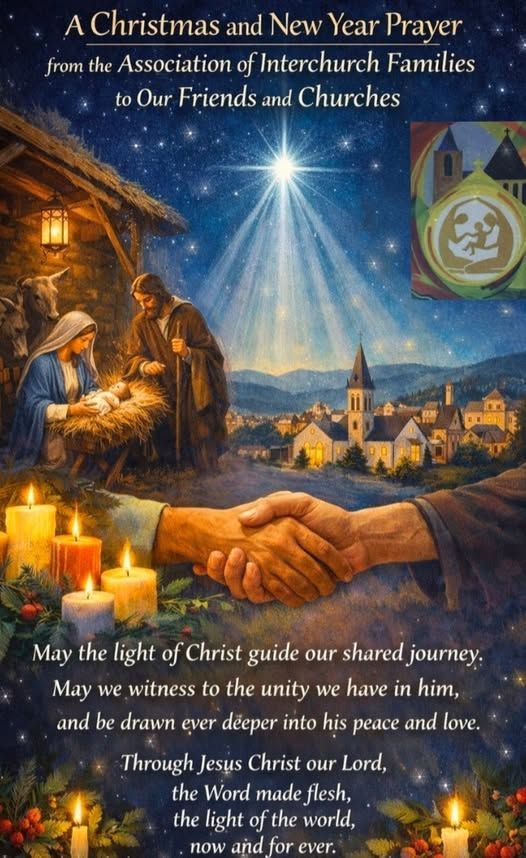
Eternal God, at Christmas we give you thanks for the gift of your Son, born among us to bring light into the world and to draw all people into your reconciling love. As the Association of Interchurch Families, we come before you as those who live daily across Christian traditions, seeking to hold together faith, family, and unity in Christ. We give thanks for the churches and friends who walk alongside us, support us, and share in this calling. At this turning of the year, we pray that the light of Christ, first seen in the manger, may continue to shape our shared life. Grant to your Church and all people a generosity of spirit, patience in difference, and a deepened commitment to the unity we share through birth and baptism. As one year ends and another begins, renew our common resolve to listen well, to learn from lived experience, and to bear faithful witness together to the truth that unity in Christ does not require uniformity, but is grounded in Love. May the joy and hope of Christmas remain with us in the year ahead, strengthening our partnerships, guiding our discernment, and drawing us ever more deeply into your peace. Through Jesus Christ our Lord, the Word made flesh, the light of the world, now and for ever.  Amen.
By Melanie Carroll November 25, 2025
If you are not already a Member of AIF we invite you to join us at our online Advent Service and Social. Please register below and we will send you out a zoom link to join us.
By Melanie Carroll October 21, 2025
Farewell to Swanwick: AIF’s 40th and Final Weekend at The Hayes
By Melanie Carroll May 28, 2025
Thy Kingdom Come 2025 - Prayers and Reflections from the Association of Interchurch Families 
By Melanie Carroll April 12, 2025
Palm Branches and Shared Pathways: Interchurch Families and the Call of Palm Sunday